How big is it?
Shadow AI tools vs shadow AI apps
| Shadow AI tools | Shadow AI apps | |
|---|---|---|
| Example | An employee signs up for an AI chatbot | An employee builds a quote calculator with Claude Code that reads the CRM |
| Found by SaaS discovery or CASB | Usually | Rarely: it's your own code |
| Risk | Data pasted into a vendor | Leaked keys, open databases, no owner when the builder leaves |
| What you need | An approved-tools list | A ledger of apps, owners and checks |
Who owns the app when the builder quits?
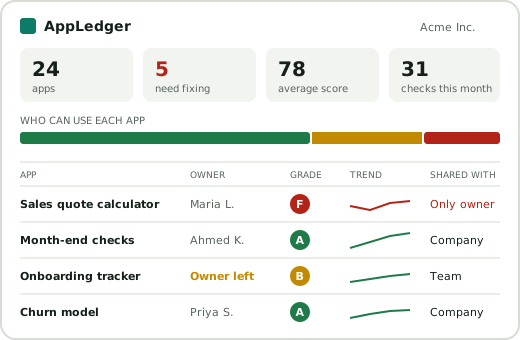
Often nobody. Engineering never saw it, the builder's team can't maintain it, and IT finds out when it breaks. A CIO.com piece describes the same gap: offboarding checklists assume people know their builds need tracking. A ledger fixes the first step: every app has a named owner, so when someone leaves you can see exactly which apps need a new one.
What to track for every AI-built app
Owner
Who built it, who owns it now.
Grade
Independent scanners, not the AI grading itself, with the trend over time.
Who may use it
Only the builder, a team, or the whole company, based on the check.
Built with
Which AI tool made it, so IT knows how to support and fix it.
Guardrails that grow with reach
Nobody waits to build something for themselves. Rules tighten only as more people depend on an app, so IT spends time where the risk is. This is a recommended policy: each check tells you which level an app is ready for, and AppLedger doesn't host apps or control who can open them.
A shadow AI app policy you can adopt this week
- Build freely, for yourself. Any approved AI tool, any personal app. No ticket needed.
- Check before you share. Run the check and fix every “fix before sharing” item before anyone else uses the app.
- No secrets in code. Keys go in a secrets store. Any key that was in code is replaced.
- Every shared app has an owner in the ledger, and a written description once the whole company uses it.
- Customer or employee data means a short IT review before company-wide sharing.
- Leaving or changing role? Hand over or retire every app you own; IT checks the ledger at offboarding.
Copy it, change it, make it yours. MSPs: use it as the starting policy for each client.
How AppLedger works today
- Create a free account and a connection key for each computer that builds apps.
- On that computer, add AppLedger to Claude Code (plugin), or to Codex or Cursor (MCP server), or use the command line, and save the key once.
- Every check lands in the ledger: app, owner, grade and who may use it. The code itself is never stored. Apps without code can be added by hand in the web app.
AppLedger doesn't scan your network or find apps by itself; it sees apps checked from connected computers. It doesn't block data (it's not DLP or a CASB), and a grade is a point-in-time result from scanners, not a certification.
Questions
What is a shadow AI app?
An app, script or agent an employee built with an AI tool such as Claude Code, Cursor, Lovable or ChatGPT and put to work without IT knowing it exists. It differs from shadow AI tools, which are the AI services people sign up for.
Does AppLedger find apps on its own?
No. It doesn't scan your network. Apps appear in the ledger when they are checked from a computer connected to your account, which builders do from their AI tool in one step.
Does it block data from leaving?
No. AppLedger is not DLP or a CASB. It shows which apps have been checked or added, who owns them and how safe they are.
Can an MSP use it for several clients?
Today, by creating a separate account per client. A single view across clients doesn't exist yet; we're exploring it with pilot members.